Ontology
What is an ontology?
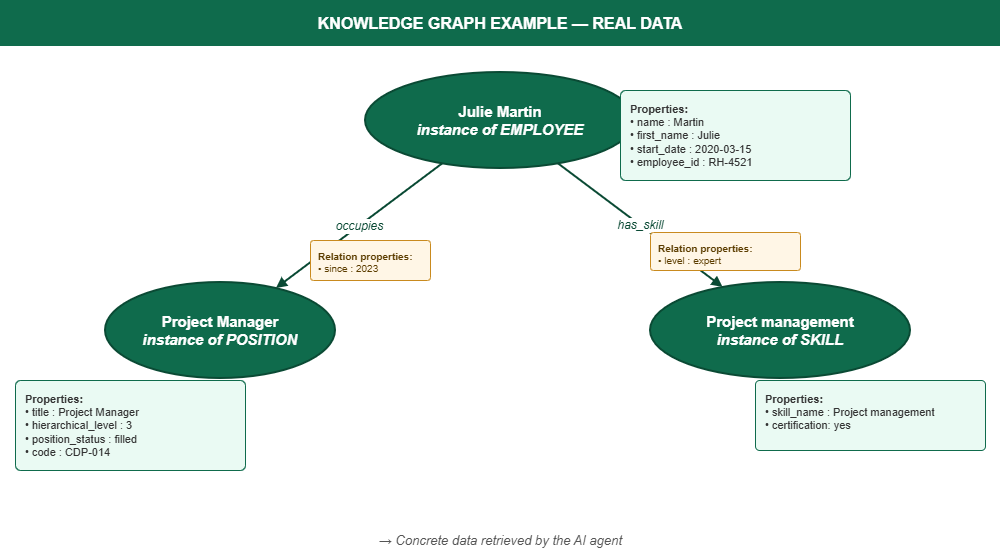
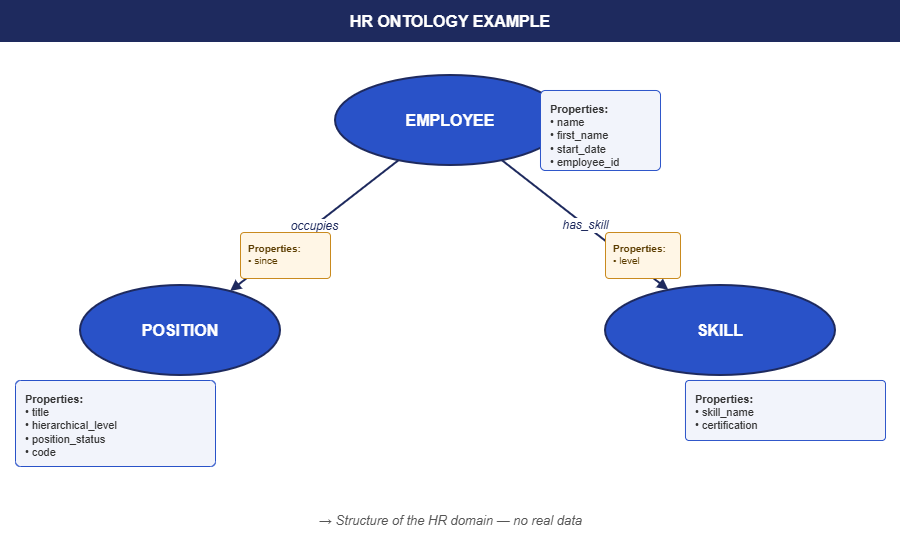
An ontology is the formal representation of the knowledge of a domain: its concepts (the nodes), their properties and the relations that link them together. It is the semantic map of your business knowledge, the one the AI agent queries to reason about your domain rather than relying on the LLM’s generic knowledge.
In the Human Resources (HR) domain, this gives for example: EMPLOYEE — holds — POSITION — requires — SKILL. Each concept (EMPLOYEE, POSITION, SKILL) is a node; each verb (holds, requires) is a relation; and properties describe each element in more detail (start date, skill level, position status…).
The augmented ontology: the same semantic map, but one that speaks your language
Traditionally, modeling an ontology takes weeks of work with business and IT teams (modeling workshops, diagrams, cross-validations). We changed the game with GraphForge, the engine of our Graphicient platform, which lets non-technical people create an ontology, import a data source to instantiate it, and make it evolve (adding/updating concepts), without depending on a traditional development cycle. Everything is done in a few clicks, at the pace of business needs, without writing a single line of code.
However, the ontology alone is not enough. It lets the AI agent answer the question “what exists?” but not “how do I understand and use it?”. For example, the AI agent does not know that a “resource”, “a staff member” or “a colleague” means the same thing as “employee” in your domain. Another example: it does not know that “seniors” means employees holding a position at hierarchical level 3. In other words, it does not have the jargon specific to your domain. Yet it is the nature of the LLM it is based on to predict rather than to know: for each word, it computes the most likely continuation of the text based on what it has learned, without distinguishing what it knows for certain from what merely seems plausible. Faced with a question that has no clear answer in its training data, it can generate a credible but false answer - a hallucination - stated with the same confidence as a correct answer.
This is precisely where the “augmentation” of the ontology comes in. In GraphForge, you can enrich the ontology with five semantic layers without writing a single line of code.
- Synonyms: the synonyms and variants that teams actually use.
- Descriptions: the business meaning of each concept, in plain language, without technical jargon.
- Business rules: the constraints specific to your business domain, which the AI agent must respect in its reasoning.
- Agent instructions: how the AI system must reason.
- Skills: reusable blocks of know-how that the AI agent reuses to answer a recurring business question the right way. They are made of three elements:
- when to use it: the situation the skill applies to
- how to answer: the steps to follow to answer
- guardrails: what to avoid, what a “good” answer looks like.
These layers are used by the AI agent and allow it to understand the business vocabulary, to know how to reason about each concept, and to answer reliably rather than guess. For example, a business user asks in natural language “which resources have a given skill?”. In practice, the user says “resources” (Synonyms, Descriptions), and the AI agent understands that this means employees. Then it follows the instruction to retrieve the EMPLOYEE nodes. It also applies the business rule that an employee on probation cannot be proposed for an external assignment. It then applies the dedicated skill to traverse the has_skill relation. It checks that the requested skill exists and reports when no employee matches, rather than producing a plausible but false answer (guardrails). Result: an exact answer, with no technical query, no IT involvement and no manual translation.